

What Does Purebred Mean What Is Seqr What Two Conclusions Makeup Mendel's Law Of Segregation
Affiliate 8: Introduction to Patterns of Inheritance
8.iii Extensions of the Laws of Inheritance
Learning Objectives
Past the stop of this section, you will be able to:
- Identify non-Mendelian inheritance patterns such as incomplete authority, codominance, multiple alleles, and sexual activity linkage from the results of crosses
- Explicate the effect of linkage and recombination on gamete genotypes
- Explain the phenotypic outcomes of epistatic effects amid genes
- Explicate polygenic inheritance
Mendel studied traits with only one mode of inheritance in pea plants. The inheritance of the traits he studied all followed the relatively unproblematic design of ascendant and recessive alleles for a single characteristic. There are several important modes of inheritance, discovered later Mendel's work, that practise not follow the dominant and recessive, unmarried-gene model.
Alternatives to Authorization and Recessiveness
Mendel's experiments with pea plants suggested that: 1) ii types of "units" or alleles exist for every factor; 2) alleles maintain their integrity in each generation (no blending); and 3) in the presence of the dominant allele, the recessive allele is hidden, with no contribution to the phenotype. Therefore, recessive alleles can be "carried" and not expressed past individuals. Such heterozygous individuals are sometimes referred to as "carriers." Since then, genetic studies in other organisms accept shown that much more complexity exists, simply that the fundamental principles of Mendelian genetics still hold true. In the sections to follow, we consider some of the extensions of Mendelism.
Incomplete Dominance
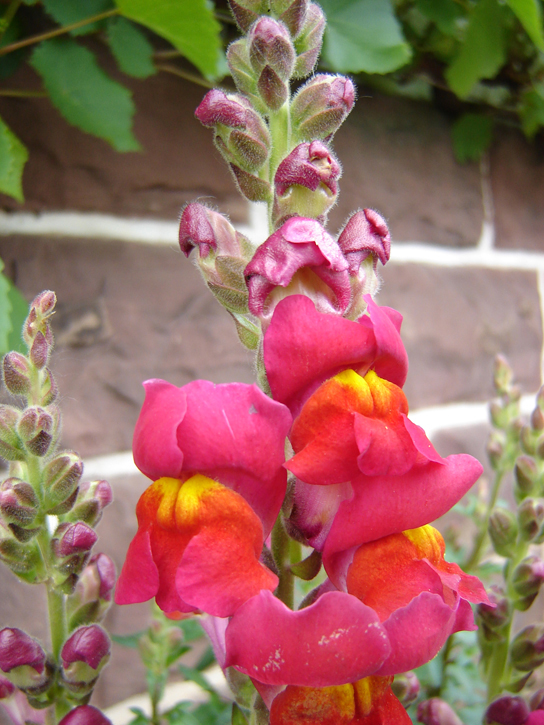
Mendel's results, demonstrating that traits are inherited every bit dominant and recessive pairs, contradicted the view at that time that offspring exhibited a blend of their parents' traits. Notwithstanding, the heterozygote phenotype occasionally does announced to exist intermediate between the 2 parents. For example, in the snapdragon, Antirrhinum majus (Figure 8.13), a cross between a homozygous parent with white flowers (CWCW ) and a homozygous parent with blood-red flowers (CRCR ) will produce offspring with pink flowers (CRCDue west ). (Note that unlike genotypic abbreviations are used for Mendelian extensions to distinguish these patterns from unproblematic dominance and recessiveness.) This pattern of inheritance is described as incomplete authorisation, meaning that one of the alleles appears in the phenotype in the heterozygote, but not to the exclusion of the other, which can also be seen. The allele for red flowers is incompletely dominant over the allele for white flowers. However, the results of a heterozygote cocky-cross can yet be predicted, just as with Mendelian dominant and recessive crosses. In this case, the genotypic ratio would be 1 CRCR :2 CRCW :one CWCDue west , and the phenotypic ratio would be 1:two:1 for red:pinkish:white. The ground for the intermediate color in the heterozygote is merely that the pigment produced by the scarlet allele (anthocyanin) is diluted in the heterozygote and therefore appears pink because of the white background of the flower petals.
Codominance
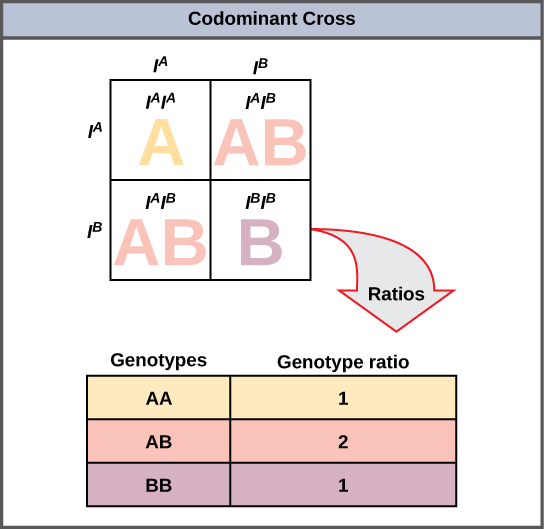
A variation on incomplete authority is codominance, in which both alleles for the same feature are simultaneously expressed in the heterozygote. An example of codominance occurs in the ABO blood groups of humans. The A and B alleles are expressed in the course of A or B molecules present on the surface of red blood cells. Homozygotes (IAIA and IBIB ) express either the A or the B phenotype, and heterozygotes (IAIB ) limited both phenotypes equally. The IAIB individual has claret type AB. In a self-cross betwixt heterozygotes expressing a codominant trait, the iii possible offspring genotypes are phenotypically singled-out. However, the 1:2:1 genotypic ratio characteristic of a Mendelian monohybrid cantankerous still applies (Figure viii.14).
Multiple Alleles
Mendel implied that simply two alleles, 1 dominant and one recessive, could exist for a given gene. We now know that this is an oversimplification. Although individual humans (and all diploid organisms) can only take two alleles for a given factor, multiple alleles may exist at the population level, such that many combinations of two alleles are observed. Note that when many alleles exist for the same gene, the convention is to denote the well-nigh common phenotype or genotype in the natural population as the wild type (often abbreviated "+"). All other phenotypes or genotypes are considered variants (mutants) of this typical form, meaning they deviate from the wild type. The variant may be recessive or dominant to the wild-type allele.
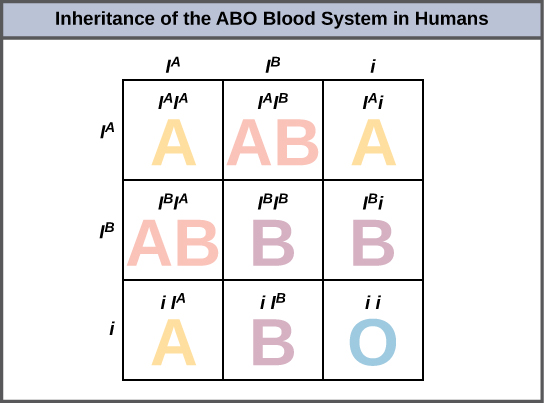
An example of multiple alleles is the ABO blood-type arrangement in humans. In this example, at that place are 3 alleles circulating in the population. The IA allele codes for A molecules on the cherry blood cells, the IB allele codes for B molecules on the surface of red blood cells, and the i allele codes for no molecules on the red blood cells. In this case, the IA and IB alleles are codominant with each other and are both ascendant over the i allele. Although there are three alleles present in a population, each individual only gets two of the alleles from their parents. This produces the genotypes and phenotypes shown in Figure viii.15. Notice that instead of three genotypes, at that place are half-dozen different genotypes when there are three alleles. The number of possible phenotypes depends on the dominance relationships between the three alleles.
Multiple Alleles Confer Drug Resistance in the Malaria Parasite
Malaria is a parasitic disease in humans that is transmitted past infected female mosquitoes, including Anopheles gambiae, and is characterized by cyclic loftier fevers, chills, flu-like symptoms, and astringent anemia. Plasmodium falciparum and P. vivax are the most common causative agents of malaria, and P. falciparum is the about mortiferous. When promptly and correctly treated, P. falciparum malaria has a mortality rate of 0.ane percentage. Still, in some parts of the globe, the parasite has evolved resistance to commonly used malaria treatments, so the about constructive malarial treatments tin can vary by geographic region.
In Southeast Asia, Africa, and South America, P. falciparum has developed resistance to the anti-malarial drugs chloroquine, mefloquine, and sulfadoxine-pyrimethamine. P. falciparum, which is haploid during the life phase in which it is infective to humans, has evolved multiple drug-resistant mutant alleles of the dhps gene. Varying degrees of sulfadoxine resistance are associated with each of these alleles. Being haploid, P. falciparum needs only 1 drug-resistant allele to limited this trait.
In Southeast Asia, different sulfadoxine-resistant alleles of the dhps gene are localized to dissimilar geographic regions. This is a mutual evolutionary miracle that comes nearly because drug-resistant mutants arise in a population and interbreed with other P. falciparum isolates in close proximity. Sulfadoxine-resistant parasites cause considerable homo hardship in regions in which this drug is widely used as an over-the-counter malaria remedy. As is mutual with pathogens that multiply to large numbers within an infection cycle, P. falciparum evolves relatively quickly (over a decade or so) in response to the selective pressure of commonly used anti-malarial drugs. For this reason, scientists must constantly work to develop new drugs or drug combinations to combat the worldwide malaria burden. 1
Sex-Linked Traits
In humans, as well every bit in many other animals and some plants, the sexual activity of the individual is determined past sex chromosomes—ane pair of non-homologous chromosomes. Until at present, we have only considered inheritance patterns among non-sex activity chromosomes, or autosomes. In addition to 22 homologous pairs of autosomes, human females have a homologous pair of 10 chromosomes, whereas human males have an XY chromosome pair. Although the Y chromosome contains a minor region of similarity to the X chromosome so that they can pair during meiosis, the Y chromosome is much shorter and contains fewer genes. When a gene being examined is present on the X, simply not the Y, chromosome, it is X-linked.
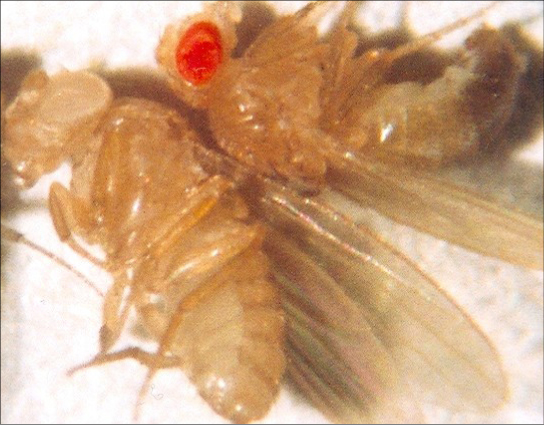
Centre color in Drosophila, the common fruit fly, was the first X-linked trait to exist identified. Thomas Hunt Morgan mapped this trait to the X chromosome in 1910. Like humans, Drosophila males have an XY chromosome pair, and females are Twenty. In flies the wild-type eye colour is ruby-red (Ten Westward ) and is dominant to white heart color (X w ) (Effigy eight.16). Because of the location of the eye-color cistron, reciprocal crosses do not produce the same offspring ratios. Males are said to exist hemizygous, in that they have only ane allele for whatsoever X-linked characteristic. Hemizygosity makes descriptions of authorization and recessiveness irrelevant for XY males. Drosophila males lack the white gene on the Y chromosome; that is, their genotype tin can but be XDue westY or X w Y. In contrast, females take two allele copies of this gene and can be X West X W , 10 West X w , or X westward X westward .
In an X-linked cross, the genotypes of F1 and F2 offspring depend on whether the recessive trait was expressed by the male or the female person in the P generation. With respect to Drosophila eye color, when the P male expresses the white-eye phenotype and the female person is homozygously cherry-red-eyed, all members of the Fi generation exhibit red eyes (Figure 8.17). The F1 females are heterozygous (X Westward X w ), and the males are all X Due west Y, having received their Ten chromosome from the homozygous ascendant P female and their Y chromosome from the P male. A subsequent cross between the Ten Due west Ten due west female and the X Due west Y male would produce only red-eyed females (with X W X W or Ten W X w genotypes) and both red- and white-eyed males (with 10 W Y or XwestwardY genotypes). At present, consider a cantankerous between a homozygous white-eyed female and a male with red eyes. The F1 generation would exhibit only heterozygous cherry-eyed females (TenWTenw) and just white-eyed males (TenwY). Half of the F2 females would exist red-eyed (XDue westXw) and one-half would be white-eyed (XwXw). Similarly, one-half of the F2 males would be reddish-eyed (XWestY) and one-half would be white-eyed (TenwestY).
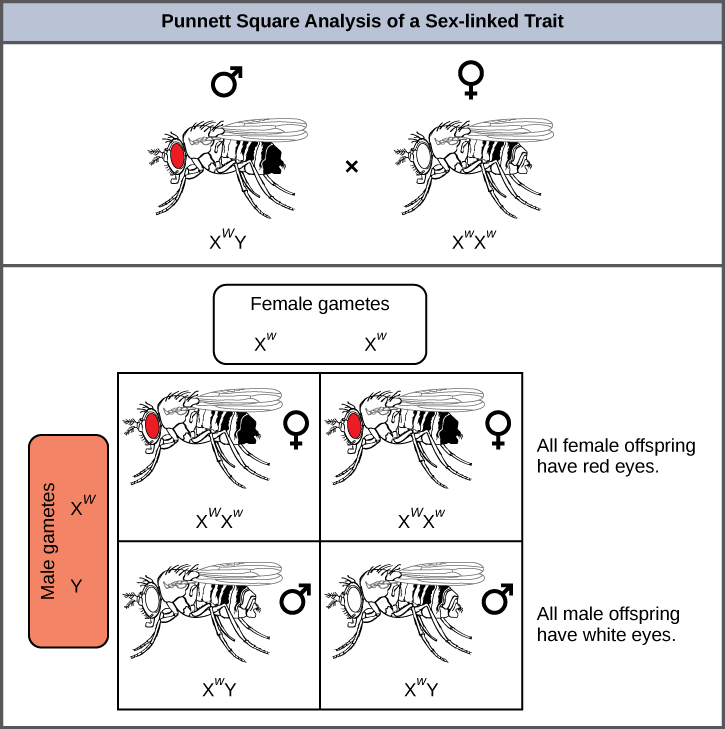
What ratio of offspring would effect from a cross between a white-eyed male and a female person that is heterozygous for ruby-red eye color?
<!–
Half of the female offspring would exist heterozygous (XW10westward) with ruddy optics, and half would be homozygous recessive (10due westXwestward) with white eyes. One-half of the male offspring would be hemizygous dominant (10WY) with red eyes, and one-half would be hemizygous recessive (TenwY) with white eyes.
–>
Discoveries in fruit fly genetics can be applied to human genetics. When a female person parent is homozygous for a recessive X-linked trait, she will pass the trait on to 100 percent of her male person offspring, because the males will receive the Y chromosome from the male parent. In humans, the alleles for certain conditions (some color-incomprehension, hemophilia, and muscular dystrophy) are Ten-linked. Females who are heterozygous for these diseases are said to be carriers and may not exhibit any phenotypic effects. These females will pass the affliction to half of their sons and will laissez passer carrier status to half of their daughters; therefore, 10-linked traits appear more than often in males than females.
In some groups of organisms with sexual activity chromosomes, the sexual practice with the non-homologous sex chromosomes is the female rather than the male. This is the example for all birds. In this case, sex activity-linked traits will exist more probable to appear in the female, in whom they are hemizygous.
Concept in Activity
Watch this video to larn more about sexual practice-linked traits.
Linked Genes Violate the Law of Independent Array
Although all of Mendel's pea establish characteristics behaved according to the law of independent array, we at present know that some allele combinations are not inherited independently of each other. Genes that are located on separate, non-homologous chromosomes will always sort independently. However, each chromosome contains hundreds or thousands of genes, organized linearly on chromosomes similar beads on a string. The segregation of alleles into gametes tin exist influenced by linkage, in which genes that are located physically close to each other on the same chromosome are more likely to be inherited equally a pair. However, because of the process of recombination, or "crossover," it is possible for two genes on the aforementioned chromosome to behave independently, or as if they are not linked. To understand this, let the states consider the biological basis of gene linkage and recombination.
Homologous chromosomes possess the same genes in the same society, though the specific alleles of the factor can be different on each of the two chromosomes. Recall that during interphase and prophase I of meiosis, homologous chromosomes offset replicate and and then synapse, with like genes on the homologs aligning with each other. At this stage, segments of homologous chromosomes exchange linear segments of genetic material (Figure 8.xviii). This process is called recombination, or crossover, and information technology is a mutual genetic process. Because the genes are aligned during recombination, the factor order is not altered. Instead, the result of recombination is that maternal and paternal alleles are combined onto the same chromosome. Across a given chromosome, several recombination events may occur, causing extensive shuffling of alleles.
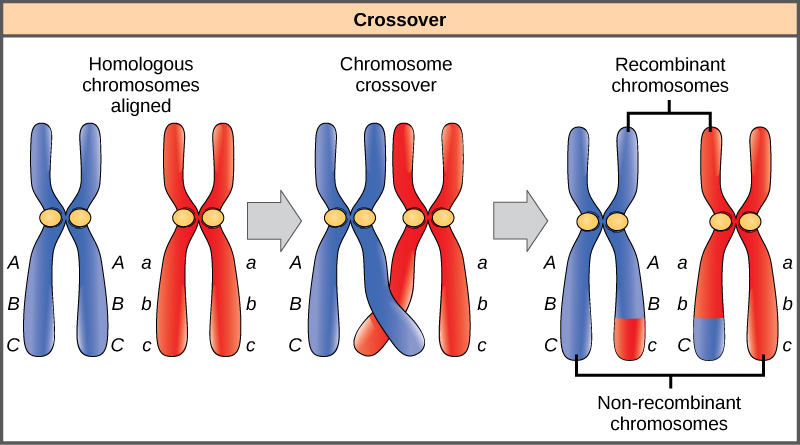
When 2 genes are located on the aforementioned chromosome, they are considered linked, and their alleles tend to be transmitted through meiosis together. To exemplify this, imagine a dihybrid cross involving flower colour and plant superlative in which the genes are adjacent to each other on the chromosome. If i homologous chromosome has alleles for tall plants and cherry flowers, and the other chromosome has genes for brusk plants and yellow flowers, then when the gametes are formed, the tall and ruddy alleles volition tend to get together into a gamete and the short and yellow alleles will go into other gametes. These are called the parental genotypes because they have been inherited intact from the parents of the private producing gametes. But dissimilar if the genes were on different chromosomes, at that place volition exist no gametes with tall and yellow alleles and no gametes with short and scarlet alleles. If you create a Punnett square with these gametes, you volition encounter that the classical Mendelian prediction of a 9:3:3:1 effect of a dihybrid cross would not use. As the distance betwixt two genes increases, the probability of i or more crossovers between them increases and the genes behave more like they are on separate chromosomes. Geneticists have used the proportion of recombinant gametes (the ones not like the parents) as a measure of how far apart genes are on a chromosome. Using this information, they take constructed linkage maps of genes on chromosomes for well-studied organisms, including humans.
Mendel's seminal publication makes no mention of linkage, and many researchers have questioned whether he encountered linkage simply chose not to publish those crosses out of concern that they would invalidate his independent assortment postulate. The garden pea has seven chromosomes, and some have suggested that his choice of seven characteristics was non a coincidence. However, fifty-fifty if the genes he examined were not located on split chromosomes, it is possible that he merely did non observe linkage because of the all-encompassing shuffling effects of recombination.
Epistasis
Mendel's studies in pea plants implied that the sum of an individual's phenotype was controlled by genes (or as he called them, unit of measurement factors), such that every characteristic was distinctly and completely controlled past a single factor. In fact, single appreciable characteristics are virtually e'er under the influence of multiple genes (each with two or more than alleles) acting in unison. For example, at least eight genes contribute to eye color in humans.
Concept in Action

Eye color in humans is determined by multiple alleles. Use the Eye Colour Figurer to predict the heart color of children from parental eye colour.
In some cases, several genes tin contribute to aspects of a common phenotype without their gene products ever directly interacting. In the case of organ development, for example, genes may exist expressed sequentially, with each gene calculation to the complication and specificity of the organ. Genes may function in complementary or synergistic fashions, such that two or more genes expressed simultaneously impact a phenotype. An apparent example of this occurs with human skin colour, which appears to involve the activity of at least three (and probably more) genes. Cases in which inheritance for a characteristic similar peel color or human pinnacle depend on the combined effects of numerous genes are called polygenic inheritance.
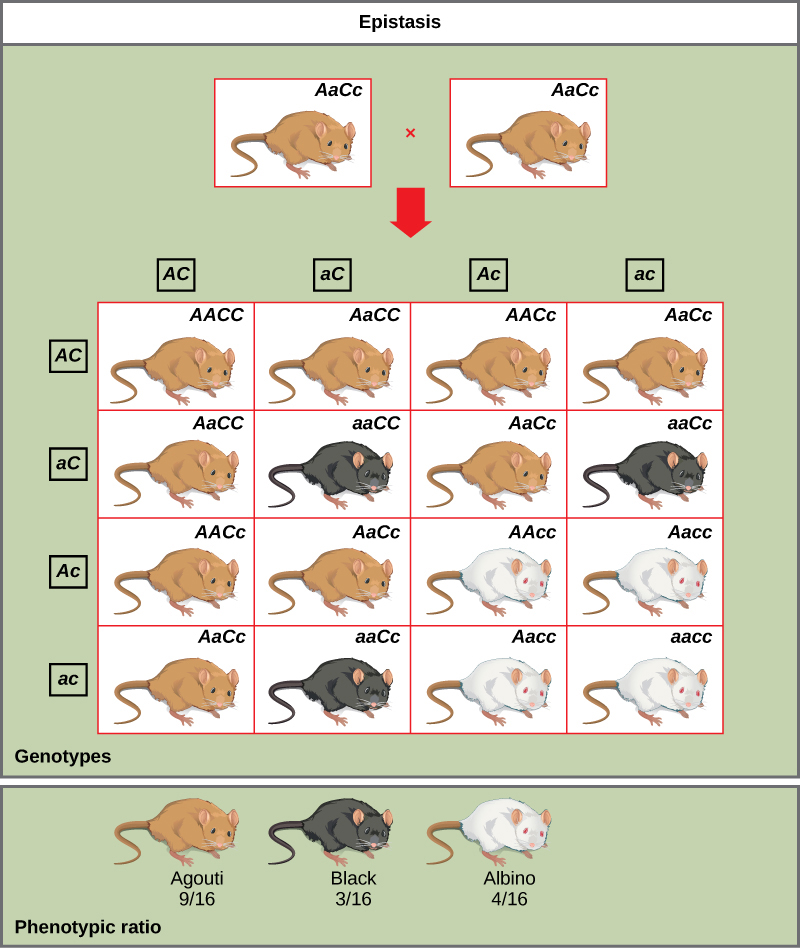
Genes may as well oppose each other, with one gene suppressing the expression of some other. In epistasis, the interaction between genes is combative, such that i gene masks or interferes with the expression of another. "Epistasis" is a word composed of Greek roots pregnant "standing upon." The alleles that are existence masked or silenced are said to be hypostatic to the epistatic alleles that are doing the masking. Ofttimes the biochemical ground of epistasis is a gene pathway in which expression of ane gene is dependent on the function of a gene that precedes or follows information technology in the pathway.
An example of epistasis is pigmentation in mice. The wild-type coat color, agouti (AA) is dominant to solid-colored fur (aa). However, a separate gene C, when nowadays as the recessive homozygote (cc), negates any expression of pigment from the A cistron and results in an albino mouse (Figure 8.19). Therefore, the genotypes AAcc, Aacc, and aacc all produce the same albino phenotype. A cantankerous between heterozygotes for both genes (AaCc x AaCc) would generate offspring with a phenotypic ratio of nine agouti:three blackness:four albino (Figure eight.19). In this case, the C factor is epistatic to the A cistron.
Section Summary
Alleles do not always bear in dominant and recessive patterns. Incomplete potency describes situations in which the heterozygote exhibits a phenotype that is intermediate between the homozygous phenotypes. Codominance describes the simultaneous expression of both of the alleles in the heterozygote. Although diploid organisms can only have two alleles for any given cistron, it is common for more than two alleles for a gene to exist in a population. In humans, as in many animals and some plants, females have ii X chromosomes and males take one 10 and 1 Y chromosome. Genes that are nowadays on the X only not the Y chromosome are said to be Ten-linked, such that males only inherit one allele for the gene, and females inherit two.
According to Mendel'due south law of contained assortment, genes sort independently of each other into gametes during meiosis. This occurs because chromosomes, on which the genes reside, assort independently during meiosis and crossovers cause most genes on the same chromosomes to too behave independently. When genes are located in close proximity on the same chromosome, their alleles tend to exist inherited together. This results in offspring ratios that violate Mendel's law of independent array. Yet, recombination serves to commutation genetic cloth on homologous chromosomes such that maternal and paternal alleles may exist recombined on the same chromosome. This is why alleles on a given chromosome are non always inherited together. Recombination is a random event occurring anywhere on a chromosome. Therefore, genes that are far apart on the aforementioned chromosome are likely to still assort independently because of recombination events that occurred in the intervening chromosomal space.
Whether or not they are sorting independently, genes may interact at the level of factor products, such that the expression of an allele for one gene masks or modifies the expression of an allele for a different factor. This is called epistasis.
Glossary
codominance: in a heterozygote, complete and simultaneous expression of both alleles for the aforementioned feature
epistasis: an interaction between genes such that one gene masks or interferes with the expression of another
hemizygous: the presence of only i allele for a characteristic, every bit in X-linkage; hemizygosity makes descriptions of dominance and recessiveness irrelevant
incomplete dominance: in a heterozygote, expression of ii contrasting alleles such that the individual displays an intermediate phenotype
linkage: a phenomenon in which alleles that are located in close proximity to each other on the aforementioned chromosome are more likely to be inherited together
recombination: the process during meiosis in which homologous chromosomes exchange linear segments of genetic material, thereby dramatically increasing genetic variation in the offspring and separating linked genes
wild blazon: the most commonly occurring genotype or phenotype for a given characteristic found in a population
X-linked: a cistron present on the 10 chromosome, only not the Y chromosome
Footnotes
i Sumiti Vinayak et al., "Origin and Evolution of Sulfadoxine Resistant Plasmodium falciparum," PLoS Pathogens 6 (2010): e1000830.
Source: https://opentextbc.ca/biology/chapter/8-3-extensions-of-the-laws-of-inheritance/
Posted by: rawsonbehimphe.blogspot.com
0 Response to "What Does Purebred Mean What Is Seqr What Two Conclusions Makeup Mendel's Law Of Segregation"
Post a Comment