

How Have Changes In Eastern Europe Altered The Enthic Makeup Of European. Countries

Attempt our email course on U.Southward. clearing
Learn nearly U.Due south. immigration through five brusk lessons delivered to your inbox every other day.
Sign up now!
At its core, demography is the human activity of counting people. But it'southward also of import to written report the forces that are driving population alter, and mensurate how these changes have an bear upon on people's lives. For example, how does immigration affect U.S. population growth? Do Americans feel that children are better off with a parent at abode, in an era when most women piece of work? How is the rise of the young-adult Millennial generation contributing to the rise of Americans with no stated religion? For this twelvemonth's Population Clan of America (PAA) annual meeting, hither is a roundup of some of Pew Inquiry Center's contempo census-related findings that tell us how America and the earth are changing.
1 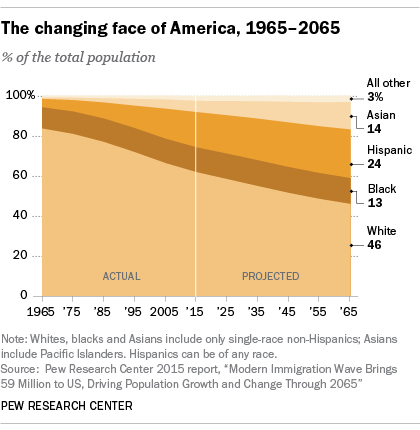 Americans are more racially and ethnically diverse than in the past, and the U.S. is projected to exist even more diverse in the coming decades. By 2055, the U.South. will not have a unmarried racial or indigenous majority. Much of this change has been (and volition exist) driven by immigration. Nearly 59 one thousand thousand immigrants have arrived in the U.S. in the past 50 years, mostly from Latin America and Asia. Today, a nearly-tape 14% of the country'south population is strange born compared with merely 5% in 1965. Over the next 5 decades, the majority of U.S. population growth is projected to be linked to new Asian and Hispanic immigration. American attitudes about clearing and diversity are supportive of these changes for the most part. More Americans say immigrants strengthen the land than say they burden it, and most say the U.S.'s increasing indigenous diversity makes it a better place to alive.
ii 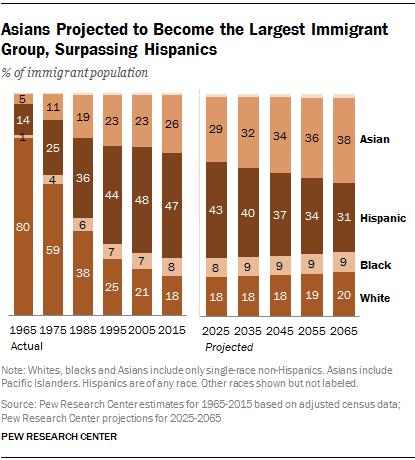 Asia has replaced Latin America (including Mexico) as the biggest source of new immigrants to the U.S. In a reversal of 1 of the largest mass migrations in modern history, net migration flows from Mexico to the U.Due south. turned negative between 2009 and 2014, every bit more Mexicans went dwelling than arrived in the U.S. And after ascent steadily since 1990, the unauthorized immigrant population has leveled off in recent years, falling to 11.3 million in 2014 from a high of 12.ii meg in 2007. Meanwhile, Asians are now the only major racial or indigenous grouping whose numbers are rising mainly because of clearing. And while African immigrants make up a modest share of the U.S. immigrant population, their numbers are also growing steadily – roughly doubling every decade since 1970.
three 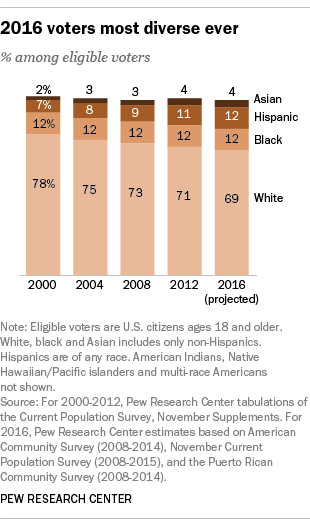 America'due south demographic changes are shifting the electorate – and American politics. The 2016 electorate will be the virtually diverse in U.S. history due to strong growth amid Hispanic eligible voters, particularly U.S.-born youth. There are as well broad gaps opening up between the generations on many social and political issues. Immature developed Millennials are much more likely than their elders to concord liberal views on many political and social issues, though they are as well less likely to identify with either political party: 50% telephone call themselves political independents.
4 Millennials, young adults born from 1981 to 1996, are the new generation to watch. Past 2019 they will surpass Baby Boomers (built-in 1946-1964) every bit the largest U.S. adult generation, and they differ significantly from their elders in many means. They are the most racially diverse adult generation in American history: 43% of Millennials are nonwhite, the highest share of any generation. And while they are on track to be the most educated generation to date, this achievement has come up at a price: Many Millennials are struggling with student debt. In addition to the weak labor market of recent years, student debt is perhaps one reason why many are still living at dwelling. Despite these troubles, Millennials are the most upbeat almost their fiscal futurity: More than eight-in-x say they either currently have plenty money to lead the lives they desire or expect to in the futurity.
Notation: Item No. 4 in this post was updated on March 23, 2018, to reflect the Middle'southward revised definition of the Millennial generation and the updated year in which Millennials volition be the largest generation.
5 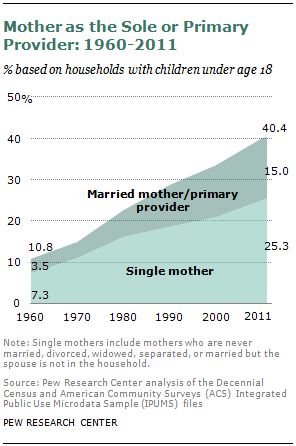 Women's role in the labor force and leadership positions has grown dramatically. The labor force participation charge per unit for American women has risen steadily since the 1960s. In fact, mothers were the sole or main breadwinner in a record twoscore% of all households with children in 2011. The gender pay gap has narrowed over this period of time, especially for immature women just entering the labor force, merely it still persists. As more than women have entered the workforce, the share of women in top leadership jobs has risen, merely they still make upwardly a small-scale share of the nation's political and business leaders relative to men. Why the continued disparity? While Americans say women are every fleck equally capable of being skillful leaders every bit men, four-in-10 believe they are held to higher standards than men and that the U.S. is simply not ready to put more than women in top leadership positions.
six 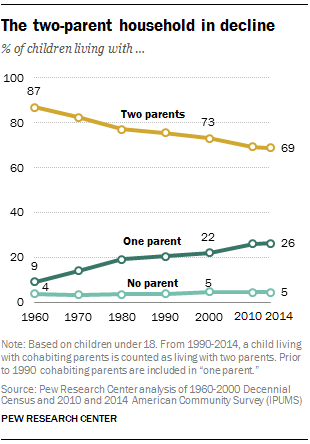 The American family is irresolute. After decades of declining marriage rates, the share of American adults who have never been married is at an historic high. Two-parent households are on the refuse in the U.S., while divorce, remarriage and cohabitation are on the ascension. Near i-in-6 American kids at present live in a blended family. And the roles of mothers and fathers are converging, due in office to the rise of breadwinner moms. Dads are doing more than housework and child care, while moms are doing more paid work exterior the home. Americans are conflicted nearly some aspects of this modify: While nearly half of two-parent households have a mom and dad who both work full time, 51% of Americans say children are better off with a mother at home.
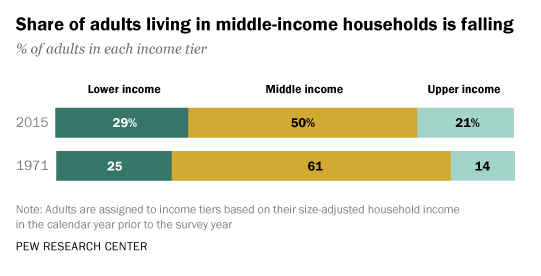
7The share of Americans who live in eye class households is shrinking. The share of U.South. adults living in middle-income households brutal to l% in 2015, after more than 4 decades in which those households served equally the nation'southward economic majority. And the financial gaps between middle- and upper-income Americans have widened, with upper-income households holding 49% of U.Due south. aggregate household income (upwardly from 29% in 1970) and seven times as much wealth as middle-income households (upwards from iii times equally much in 1983). Well-nigh Americans say the regime doesn't do plenty to help the middle class, and neither party is widely viewed every bit a champion for middle-class interests.
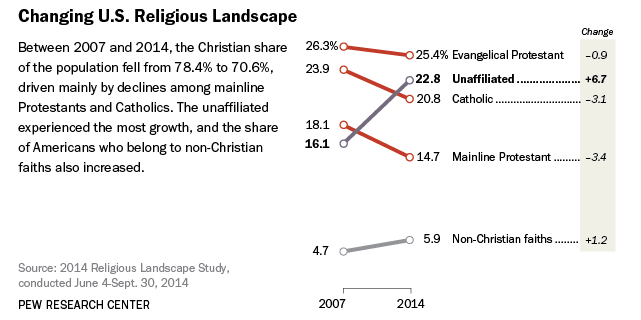
8Christians are failing as a share of the U.Southward. population, and the number of U.S. adults who do not place with any organized religion has grown. While the U.S. remains home to more than Christians than any other land, the percentage of Americans identifying as Christian dropped from 78% in 2007 to 71% in 2014. By contrast, the religiously unaffiliated accept surged seven percentage points in that fourth dimension span to make up 23% of U.S. adults final twelvemonth. This trend has been driven in large part by Millennials, 35% of whom are religious "nones." The rise of the "nones" is not a story unique to the U.S.: The unaffiliated are now the second-largest religious grouping in 48% of the world'south nations. Americans are well aware of this shift: 72% say religion's influence on public life is waning, and nigh who say this meet information technology equally a bad thing.
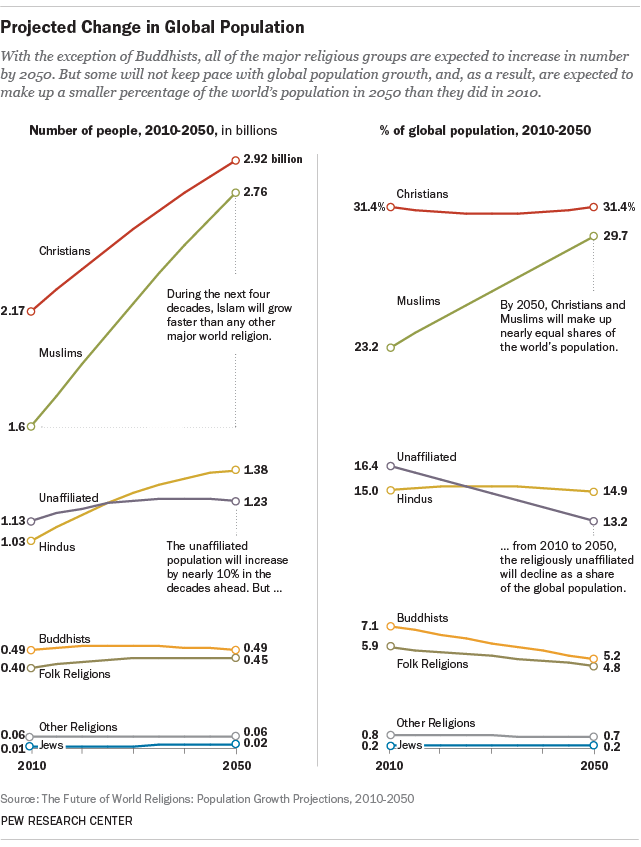
9The earth'due south religious makeup will look a lot different by 2050: Over the next four decades, Christians volition remain the largest religious grouping, but Islam will grow faster than whatever other major organized religion, by and large because Muslims are younger and have more than children than any other religious group globally. By 2050, the number of Muslims will nearly equal the number of Christians. In the U.S., the Muslim population volition remain small, but is projected to grow apace.
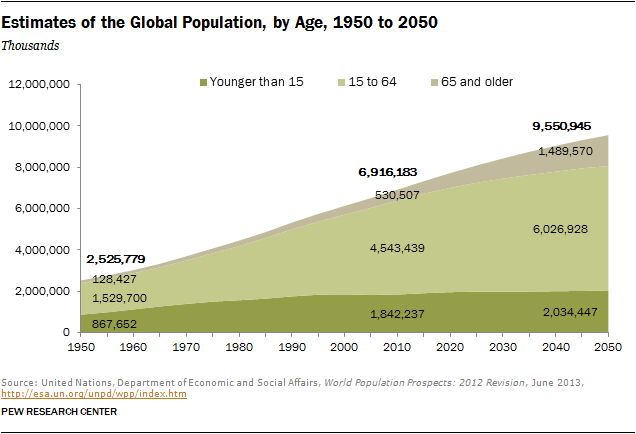
10The world is aging. The demographic time to come for the U.S. and the world looks very different than the recent past. Growth from 1950 to 2010 was rapid — the global population nearly tripled, and the U.S. population doubled. However, population growth from 2010 to 2050 is projected to be significantly slower and is expected to tilt strongly to the oldest age groups, both globally and in the U.S. Public opinion on whether the growing number of older people is a trouble varies dramatically around the world. Business organisation is highest in Eastern asia where big majorities depict aging every bit a major problem for their countries.
Annotation: Item No. 4 in this post was updated on March 23, 2018.

D'Vera Cohn is a senior writer/editor focusing on immigration and demographics at Pew Research Center.

Andrea Caumont is the digital engagement manager at Pew Research Eye.
Source: https://www.pewresearch.org/fact-tank/2016/03/31/10-demographic-trends-that-are-shaping-the-u-s-and-the-world/
Posted by: rawsonbehimphe.blogspot.com
0 Response to "How Have Changes In Eastern Europe Altered The Enthic Makeup Of European. Countries"
Post a Comment